
The counterintuitive truth about a mobile crypto wallet is that an in-wallet exchange can expose a user to more moving parts than a traditional exchange, not fewer. The screen may show only two assets, an amount, and a confirmation button, but behind that simplicity are liquidity providers, pricing systems, network fees, settlement rules, and sometimes a third-party exchange service. For privacy-focused users, the central question is therefore not merely whether a wallet can swap Bitcoin, Monero, or another cryptocurrency. It is whether the swap preserves the properties that made self-custody valuable in the first place.
This distinction matters when considering Haven Protocol, a privacy-oriented project designed around private transactions and a family of blockchain-based synthetic assets. Haven’s model is intellectually different from a simple coin swap: it attempts to represent value through protocol mechanisms rather than relying only on a marketplace matching one buyer with one seller. That ambition creates useful flexibility, but it also introduces assumptions about collateral, price information, incentives, and governance. A mobile wallet is the interface; it is not the whole financial system underneath.
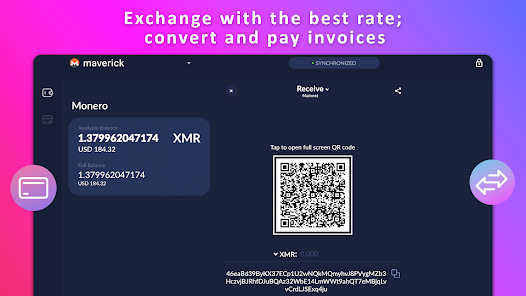
What “exchange in wallet” actually means
In-wallet exchange is best understood as an orchestration service. The wallet holds or controls the user’s keys, but the conversion may be executed through several different designs. A custodial route sends funds to a service that performs the trade and returns another asset. A non-custodial route may use an automated market maker, an order-book venue, or a swap protocol. An aggregation route searches multiple providers and presents one transaction flow to the user.
These designs have different trust boundaries. A custodial swap can be convenient, but the user temporarily depends on another party to receive and return funds. A decentralized route may reduce that custody risk, yet it can create smart-contract risk, slippage, complicated fee structures, or transparent transaction data. The phrase “inside the wallet” does not identify which model is being used. Users should ask where the trade occurs, who controls the assets during execution, and what information the provider can observe.
For a privacy-conscious person in the United States, the practical issue is broader than hiding a balance. A provider may observe an IP address, device information, wallet addresses, transaction timing, requested assets, and an approximate trade size. Even when the underlying blockchain offers strong transaction privacy, metadata around the exchange can form a revealing profile. Network-level privacy tools and careful address practices may therefore matter as much as the wallet’s cryptographic design.
Why Haven Protocol changes the comparison
Haven Protocol is associated with private transactions and synthetic representations of assets, commonly described as xAssets. The intended mechanism uses the network’s native collateral and protocol rules to create or retire representations whose value is linked to external price references. In broad terms, this differs from exchanging XHV for Bitcoin through a service: the protocol is trying to provide exposure to a unit of account while preserving private transfer characteristics within its own ecosystem.
The important conceptual distinction is between ownership privacy and price stability. Privacy can make it harder for outside observers to connect transactions and amounts. Stability, by contrast, depends on collateral, pricing inputs, redemption incentives, market confidence, and the ability of participants to act when conditions deteriorate. A private asset is not automatically a stable asset, and a synthetic asset is not the same as direct ownership of dollars, gold, or another underlying instrument.
That is where Haven’s design becomes analytically interesting and operationally demanding. Synthetic assets can reduce the need to move between multiple external markets, but they rely on an economic mechanism that must remain solvent and correctly incentivized. If collateral value falls sharply, pricing data becomes unreliable, liquidity dries up, or users rush for the exit, the protocol’s intended relationship between the synthetic asset and its reference value can weaken. The limitation is structural, not a flaw that a polished mobile interface can remove.
Three exchange routes, three different compromises
Wallet-integrated services
A wallet-integrated service is usually the easiest route for a newcomer. The user selects an asset, reviews a quote, and authorizes the transaction. This reduces operational friction and can be useful for small, routine conversions. The cost is opacity: the quoted rate may include a service margin, the execution venue may not be obvious, and privacy policies can vary substantially. Convenience should be treated as a product feature, not evidence that the exchange is trustless.
For readers evaluating a mobile wallet, a useful starting point is to inspect its supported assets, fee disclosure, transaction preview, backup process, and permission model. A resource such as cake wallet download may help users begin that evaluation, but downloading a wallet should never substitute for verifying the official source, checking the recovery phrase workflow, and understanding whether an exchange feature is native or provided by a third party.
Centralized exchanges
A centralized exchange generally offers deeper liquidity, familiar market orders, and clearer trading tools. For Bitcoin and many large assets, that can mean lower slippage than a thin in-wallet route. The sacrifice is significant for privacy-focused users: identity verification may be required, account activity is associated with a customer profile, and withdrawals create a bridge between a regulated platform and a self-custodied address.
Centralized venues also introduce account and counterparty risk. A user may face withdrawal delays, geographic restrictions, banking-related complications, or a platform decision that affects access. Those risks do not make centralized exchanges universally unsuitable. They mean the venue is better understood as a regulated financial intermediary rather than a neutral pipe between wallets.
Peer-to-peer and decentralized swaps
Peer-to-peer trades and decentralized swaps can reduce dependence on a single intermediary. In principle, they may offer stronger control over settlement and allow users to choose among liquidity sources. In practice, they shift responsibility toward the user. The trader must understand time limits, pricing, routing, contract permissions, failed transactions, and the possibility that a quoted price changes before confirmation.
Atomic swaps, where technically and economically supported, offer an especially appealing model because neither party should need to trust the other to complete the exchange. Yet “atomic” does not mean risk-free. Liquidity may be limited, supported pairs may be narrow, and the user can still reveal network metadata or make an irreversible mistake. A mechanism can remove one category of trust while leaving several others intact.
A decision framework for privacy-focused users
The right question is not “Which exchange is safest?” in the abstract. It is “Which failure can I tolerate?” If the priority is speed and modest-value conversion, an integrated service may be reasonable after reviewing its disclosures. If the priority is liquidity and advanced execution, a centralized venue may fit, with the obvious privacy and custody compromises. If minimizing intermediaries matters most, a self-directed or decentralized method may be preferable, provided the user can evaluate technical and market risks.
Before confirming an exchange in a mobile wallet, compare the displayed rate with an independent market reference, identify the network fee separately from the provider fee, and check whether the recipient address is correct. Consider the total amount that could be lost if the phone is compromised, the transaction fails, or the service becomes unavailable. Test recovery with a small balance before treating the wallet as a long-term vault. For Monero in particular, users should also understand that privacy depends on correct wallet synchronization, address handling, and protection of view-related information—not simply on selecting a privacy-branded application.
Haven Protocol adds another layer to this checklist. A user should distinguish between holding the native asset, holding a synthetic asset, and swapping into or out of either through an external service. These are different exposures. They involve different liquidity conditions, different dependencies on price information, and different ways a technical or economic failure could appear. A synthetic asset can be useful for a particular purpose, but it should not be described as equivalent to a bank-held dollar or a directly held commodity.
What to watch next
Because no recent project-specific news is available for the current reporting period, the most useful signals are structural rather than headline-driven. Watch whether wallet interfaces clearly disclose exchange counterparties, whether privacy-preserving assets retain practical liquidity, and whether protocols can explain their collateral and pricing assumptions in terms an ordinary user can audit. Also watch the gap between nominal privacy and operational privacy: a transaction may be cryptographically private while the surrounding service still creates a detailed behavioral record.
If mobile wallets increasingly combine custody, swapping, portfolio tracking, and synthetic assets, the boundary between a wallet and a financial platform will become harder to see. That may improve usability, but it also raises the cost of informed consent. The strongest products will not merely hide complexity; they will expose the decisions that matter, including who executes a trade, what data is collected, and what happens when liquidity or connectivity disappears.
Frequently asked questions
Is an exchange inside a mobile wallet automatically non-custodial?
No. The wallet may be self-custodial while the exchange feature relies on a separate service that temporarily receives funds or controls execution. Read the transaction flow and terms rather than inferring the custody model from the interface.
Is Haven Protocol the same as exchanging Bitcoin for Monero?
No. A Bitcoin-to-Monero swap is a conversion between two native cryptocurrencies. Haven’s synthetic-asset model involves protocol-created representations of value and depends on collateral, pricing mechanisms, and market confidence. The privacy characteristics and economic risks are therefore not identical.
What is the simplest privacy rule for wallet exchanges?
Separate convenience from confidentiality. Use only the funds needed for the transaction, examine what information the service can collect, avoid reusing addresses when the wallet design advises against it, and keep long-term holdings away from experimental or poorly understood exchange mechanisms.
The exchange button is only the visible tip of the system. Beneath it sit questions of custody, liquidity, metadata, collateral, and user responsibility. For privacy-focused users, the best wallet is not necessarily the one with the most features. It is the one that makes those hidden trade-offs understandable before an irreversible transaction is approved.